The media loves soundbites, and the three debates so far have not provided them with much of a fix, which is why I expect that we'll be hearing a lot of "that one" references in the coming weeks. It's silly because that is far from the most uncivil thing that John McCain has said about Obama, but expecting rationality to apply to American politics is a sure-fire path to disappointment. The media is already disillusioned by the shift from the reporter-friendly, independent-minded McCain of 2000 to the new disciple of Rovian political manipulation and media-bashing, and the many headlines and other mentions of the "that one" moment make it clear that the media is not going to resist the allure of a lovely soundbite just because it is unfair to 2008 McCain.
In an otherwise boring debate, that brief cringe-worthy moment will be the only thing that is remembered. John McCain has established the soundbite that will cling to him as he struggles over the next four weeks to overcome the growing support for Obama, and the words that will be ringing in his ears as his campaign goes down in defeat will be "that one."
Of course, it doesn't help that the record that John McCain is constantly crowing about shows that he does not support breasts:
I think the whole McCain campaign's problem is summed up pretty well by this picture that my Aunt Laura sent me:
Who needs a thousand words when you've got trains?
Wednesday, October 8, 2008
I get to choose "my friends," and I pick "that one."


Friday, October 3, 2008
Sarah Palin Saves her Career
The debate last night was every bit as meaningless as I thought it would be from the moment that I found out that the joke of a debate format would allow Palin to spout canned responses for 90 seconds without ever being forced to deal with a follow-up question. Her strategy is presented very clearly in this flow chart from Aden Nak (via Boing Boing):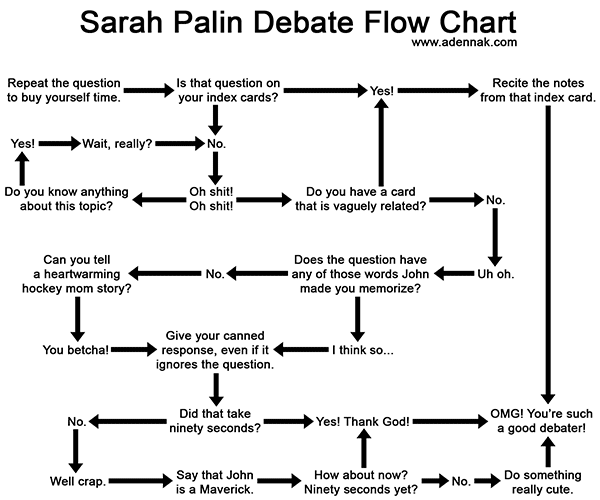
It's a shame for Joe Biden that this debate was framed by recent events in such a way that it was all about Palin, as the only way that his performance would be noticed was if he had put his foot in his mouth or had gotten Palin to self-destruct (which the format made almost impossible). Joe Biden presented himself very well to those who didn't know him, and more importantly he showed the people, myself included, who thought we knew him, that he's not just a good vice-presidential pick, he's outstanding.
Biden gets a win for presenting himself to the nation and showing us how lucky we are to have had him as a public servant for the last few decades. Palin gets a win for salvaging her collapsing image by exceeding the subterraneanly low expectations for her, thus avoiding becoming a national joke and a shoo-in scapegoat for a McCain loss. The loser in this debate was John McCain, who got ripped to shreds by Biden and who gains very little from Palin stopping the bleeding about her disastrous interviews because his campaign still has a sucking chest would in the form of his inescapable connection to the Republican policies that have led us into an inexcusable war and a spiraling economic crisis.
Tuesday, July 22, 2008
Introverts and separations
The realization that my summer is rapidly drawing to a close has resulted in a lot of aimless wandering through the goody-filled halls of the Internet, and today I came across an old article from The Atlantic that does a better job of expressing what it means to be an introvert than anything else I've ever read on the subject. Now if only there were a way to make extroverts realize how true it is...
I've also been following the horrified responses to recently upheld law in South Dakota that forces doctors to read a scripted statement (which was written by the legislature and has an only tangential relationship to science and reality). Even before you get to the free speech problems and the garbage science it is based on, the statement has a serious problem with basic logical coherence. As pointed out in the Human Nature blog on Slate, if a fetus is "a whole, separate, unique, living human being" then nobody needs to worry about getting an abortion, which the state defines as "the use of any means to intentionally terminate the pregnancy of a woman known to be pregnant with knowledge that the termination with those means will, with reasonable likelihood, cause the death of the fetus." If the fetus is already whole and separate, then who could think that there's a reasonable likelihood that removing it from the womb would cause its death?
Sunday, June 8, 2008
Coronation to Yes We Can in 517 seconds
Slate has a great video summing up the entire Democratic primary in just eight minutes. It says a lot about how much happened since last fall that even going at warp speed it takes them that long to get through it all.
Wednesday, June 4, 2008
Snuffing out other people's candles to make yours look brighter
Finals are still going on, so I'll keep this to some quick links. A larger post on the long-awaited conclusion of the Democratic primary contest is forthcoming.
ESPN.com has some news that Tiger Woods is apparently unaware of how boring his sport is to watch on television, so he's dissing hockey.
There's an interesting piece in Slate about how Eugene McCarthy's stubborn unwillingness to reconcile with the Kennedy supporters weakened the party in the months after RFK's assassination. In addition to the obvious political interest, there's also a fascinating bit about how McCarthy insulted the state of Indiana (which supported Kennedy) because they hadn't produced a poet to rival his friend Robert Lowell. It's amazing how much things have changed since 1968.
To finish, the Onion has an especially funny piece poking fun at John Grisham.
Thursday, April 17, 2008
What a cinematic painting! It's so much better than that theatrical novel.
Robert Pinsky has a piece about poetry in Slate today that I couldn't let pass without comment. is set up as a casual FAQ about poetry, and he makes some interesting points, but some of his responses are oddly lacking in analysis for a piece that is supposed to be answering questions. "Read this" is a rather unsatisfying answer when one has a legitimate question. He also makes a great point about the false nostalgia that imagines that there was some kind of Golden Age in which poetry was "easy to understand and great".
What I really wished he had addressed in more detail was the question of song lyrics as poetry. Ben (who is a musician) and I have debated this point on a few occasions, and the point I always come back to is that they are two different forms of art that work in different ways. One of the flaws that turns me off to a lot of contemporary music is that each song is so packed with lyrics that the balance between the emotional content of the words and the emotional content of the sound is thrown completely out of whack. The claim that song lyrics are poetry implies that music cannot stand on its own merits, that it needs to draw upon poetry because the medium lacks artistic validity.
It's a back-handed compliment when an artistic work is compared to another medium in a way that implies that the other medium is inherently superior. It reminds me of a recent class discussion about what it means to say that Henry James has an "Impressionist" style of writing. A novel is not a painting, and it is demeaning to the writer's craft to give up on trying to understand a piece of writing on its own terms by clumsily applying the language of a different artistic discipline.
Monday, March 17, 2008
Failing a saving throw against health problems and old age
The news is a couple of weeks old now (and thus has already been on Wait Wait... Don't Tell Me), but I have to post something on the passing of Gary Gygax. In case there was any doubt about my nerd credentials, I am also a big fan of Dungeons & Dragons. The necessity of having a group was always a limiting factor, but I could fill in the gaps with computer versions like the excellent Baldur's Gate games. The only reason I'm not still playing it now is that the friends I played as an undergrad all graduated and went to different places.
I actually my first exposure to D&D in the form of Gygax's first edition of the rules, a set that had been left in our basement by my half-brother many years before. It is difficult to recall that many of the fundamental concepts of the entire genre of role-playing games were invented by just one man. It's disappointing that the business side of things and the various legal battles cast a shadow over the last few decades of his career, but he will be remembered for creating a game that made the trials of awkward youth a little less painful.
Tuesday, February 12, 2008
Obama Sweeps the Potomac
Barack Obama's win in the Potomac Primaries is impressive, giving him eight victories in a row, but the bigger news is that he won among those who were supposed to belong to Hillary. Regardless of what the pundits say, the whole momentum factor remains minor because it takes effect when voters perceive that they would be throwing their votes away if they went against the momentum, and at this stage there's no way that Clinton supporters are going to conclude that she's a lost cause. Barring an a reversal in Wisconsin or Hawaii, Barack will be heading into the contests on March 4th (Texas, Ohio, Vermont, and Rhode Island) with a substantial delegate lead and victories in half of the states in the nation. So far, Huckabee has delayed McCain's nomination on the Republican side, but McCain's narrow victories in today's primaries will probably hasten Huckabee's withdrawal. Hopefully Obama can win both Ohio (looking increasingly plausible) and Texas (still doubtful, but winning among Latinos in Virginia gives hope), which would allow him to get the full force of the party behind him and start preparing for the general election.
I also came across a delightfully geeky website this evening. If you've ever wondered how a Star Destroyer and the Enterprise would look next to each other (or the relative sizes of any other science-fiction vehicles), this site has the answers. It's particularly nifty that he provides some real-world examples too. I like that Serenity is almost as big as a 747, and comparing things to the Empire State Building is far more fun than you'd think...
Thursday, January 17, 2008
The Moral Aspect of a Sledgehammer
This evening I went to see the world premiere of Lydia, a new play that was commissioned by the Denver Center for the Performing Arts. It was extremely well-executed and powerful, but it also left me asking Why? The actors turned in excellent performances working with very difficult material, but I struggle to see what the playwright and the director were trying to accomplish. It was a brilliant sledgehammer of a play, but aside from the emotional spectacle of watching a family tear itself apart, I couldn't see that it accomplished anything.
That raises the question of whether art needs to have a "purpose" or if it should just be allowed to exist completely detached from moral considerations in a bubble of "art for art's sake". My feeling is that while art need not have a moral agenda, the artist must still take into consideration that it does exist in a moral world. Sometimes audiences need a play to be a sledgehammer that smashes ideas or expectations, but there's a reason we speak disparagingly of "shock value", and it is a shame that a play full of such beautifully crafted scenes ultimately did nothing more than revel in a spectacle of rage, guilt, and destruction.
At what point do the desires of the reading public override those the authors who provide the literature we crave? Does a writer's control over his work diminish in proportion to his greatness? I have no answers that can diminish my visceral feeling that the manuscript shouldn't be destroyed, and I feel like my inability to make up my mind on this issue is a failing on my part.